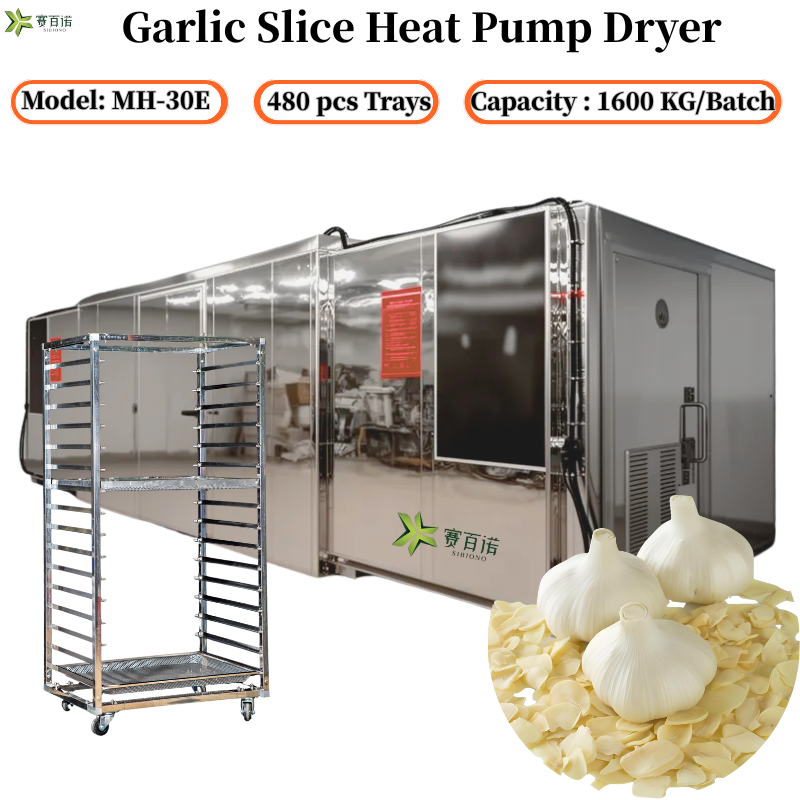
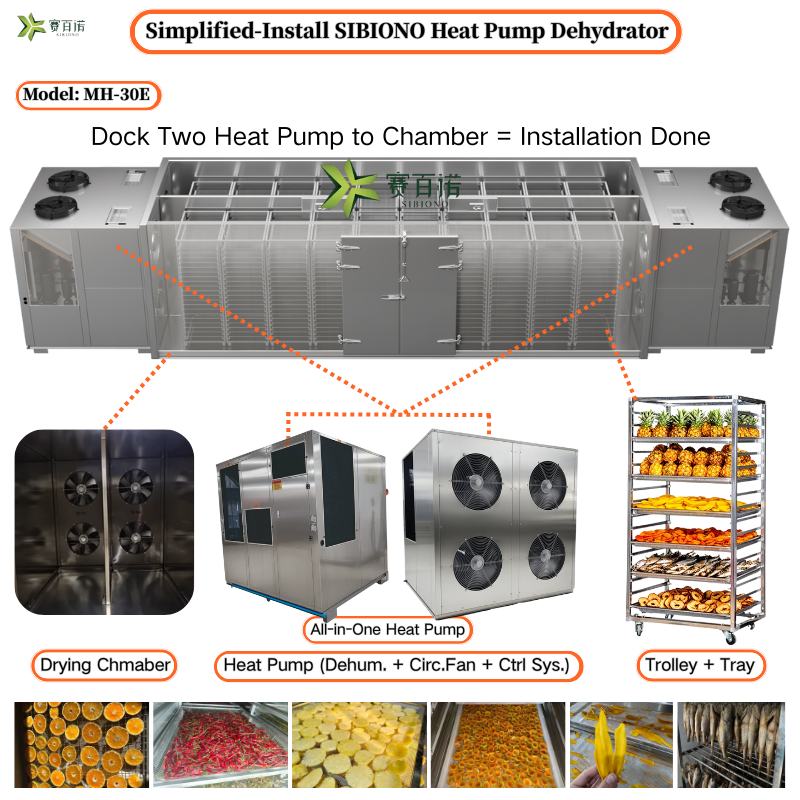
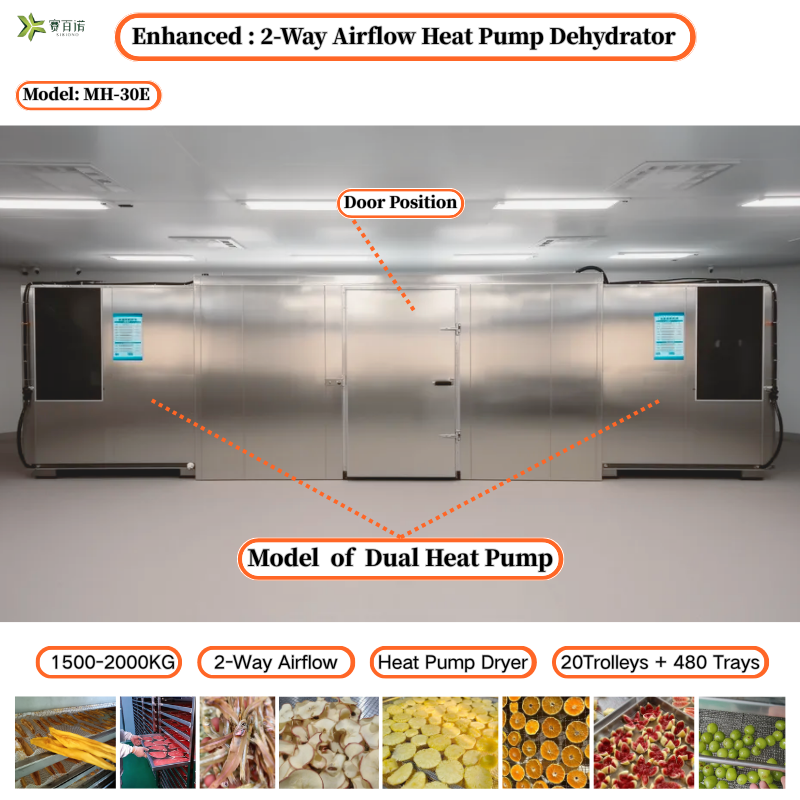
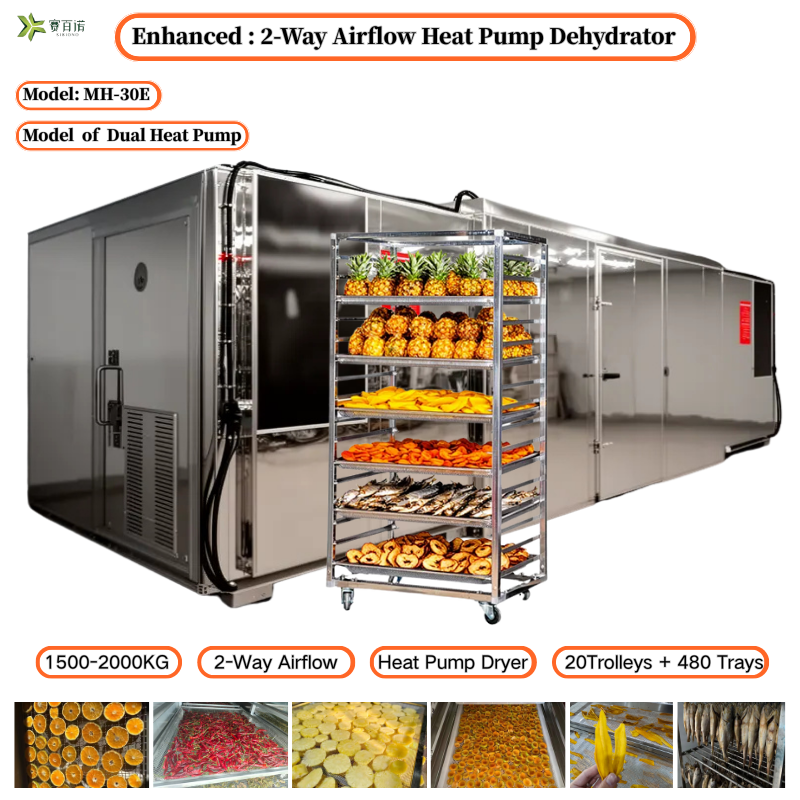
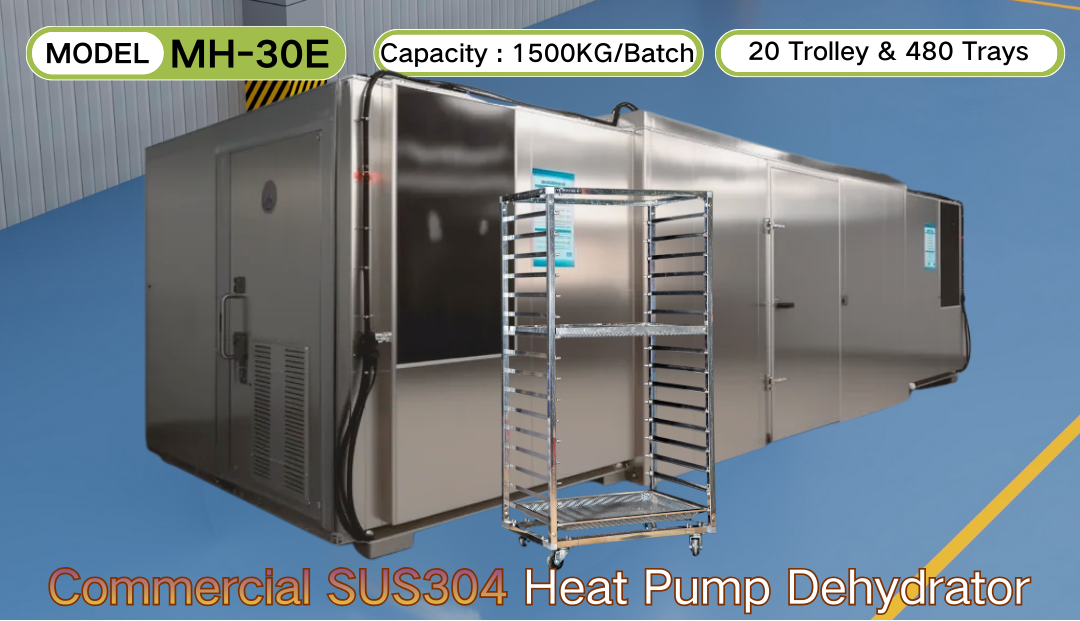
1500KG/Batch MH-30E Commercial Garlic Dehydrator, Professional Heat Pump Vegetable Dryer & Food Processing Equipment

Product Description

Heat Pump Dehydrator Introduction
1. Old Heat Pump Dehydrator
Traditional Airflow Diagram
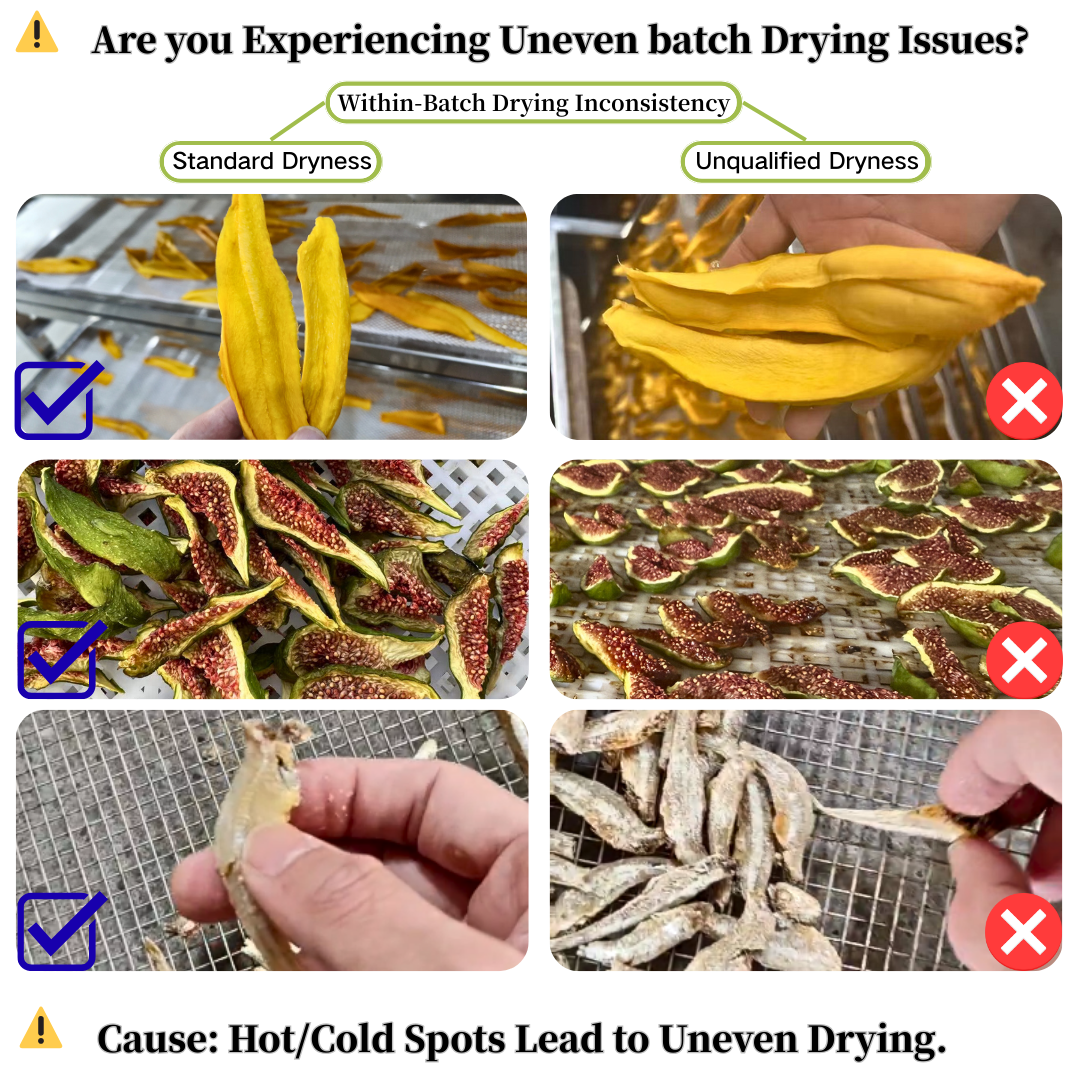
In-depth analysis of the problem
  • Physical Premise: Solids and liquids in the product must absorb heat to evaporate moisture.
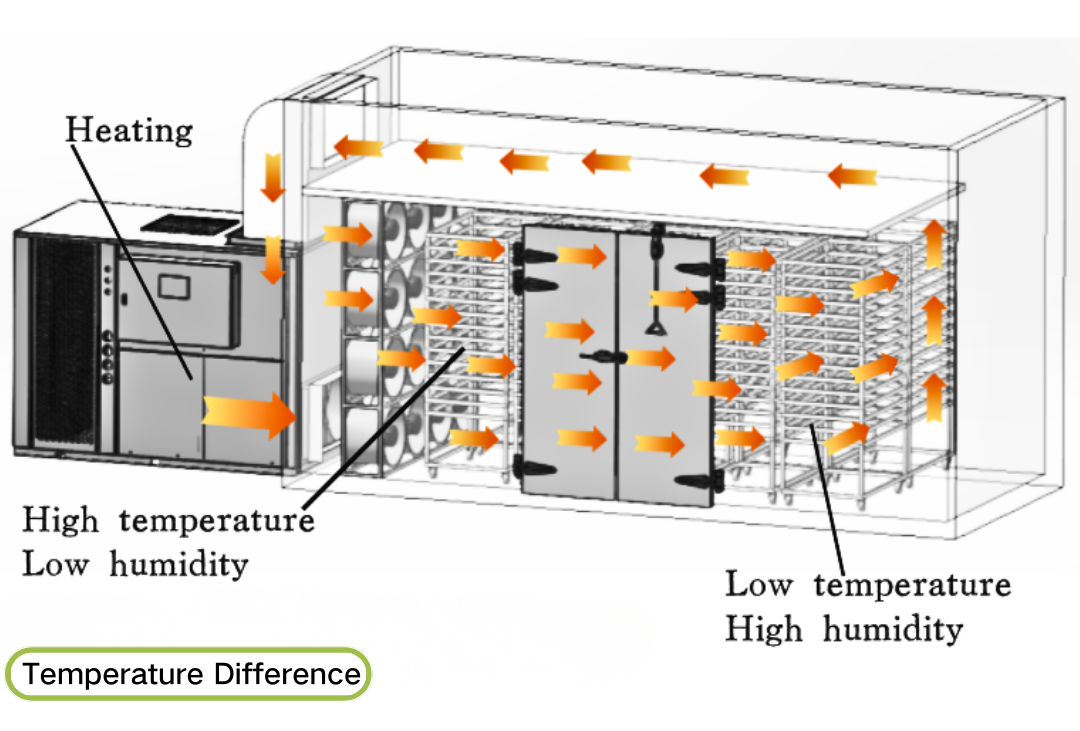
  • Dehydrator Airflow: The heat pump produces heat, delivered by fans into the drying chamber for circulation.
  • Airflow & Product Interaction: Hot air passes over the product, which absorbs heat, continuously lowering the air temperature.
  • Conclusion: A unidirectional hot airflow system results in:
    • Full load: Clear temperature differences between left/right or front/rear zones.
    • Near the fan: Products absorb more heat and dry faster.
    • Far from the fan: Products absorb less heat and dry slower.

Example: Below are two classic unidirectional airflow heat pump dehydrators (older versions).
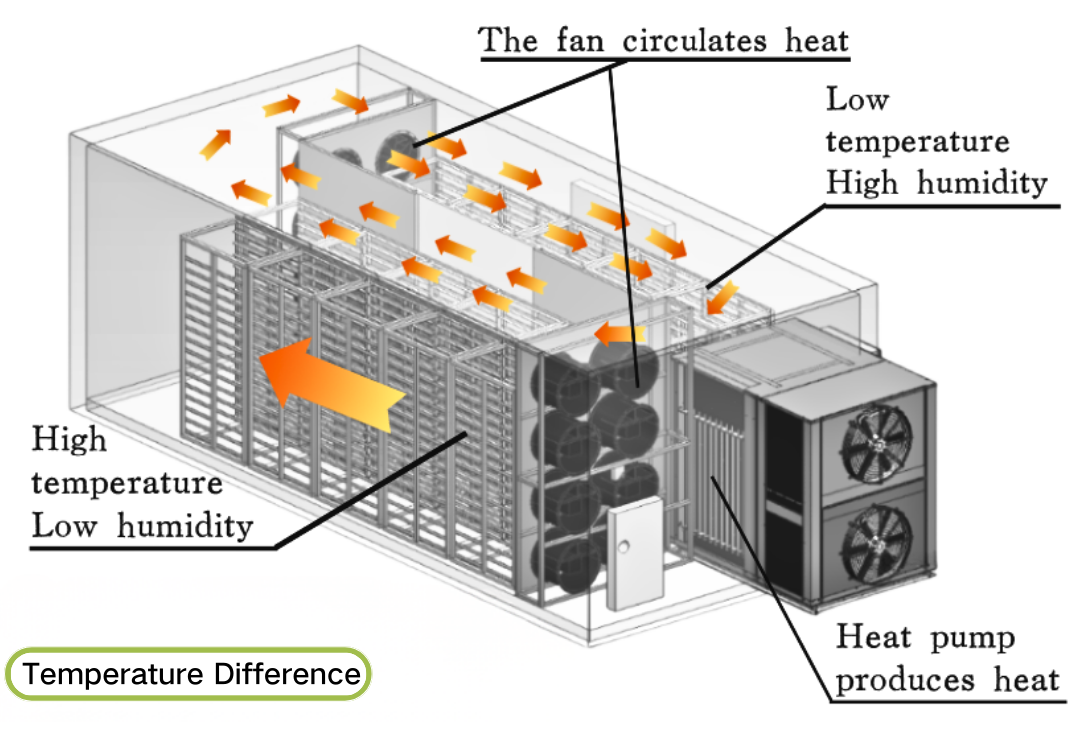
Unidirectional Dehydrator Example 1
Unidirectional Dehydrator Example 2
2. Two Way Airflow Dehydrator
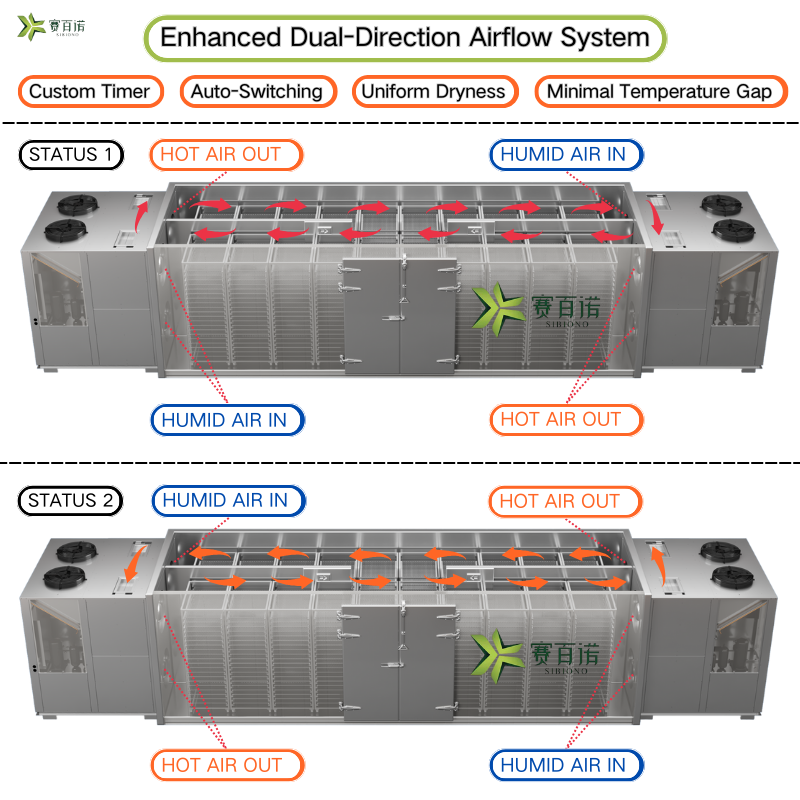
How does the Bidirectional Airflow System solve inconsistent batch drying?
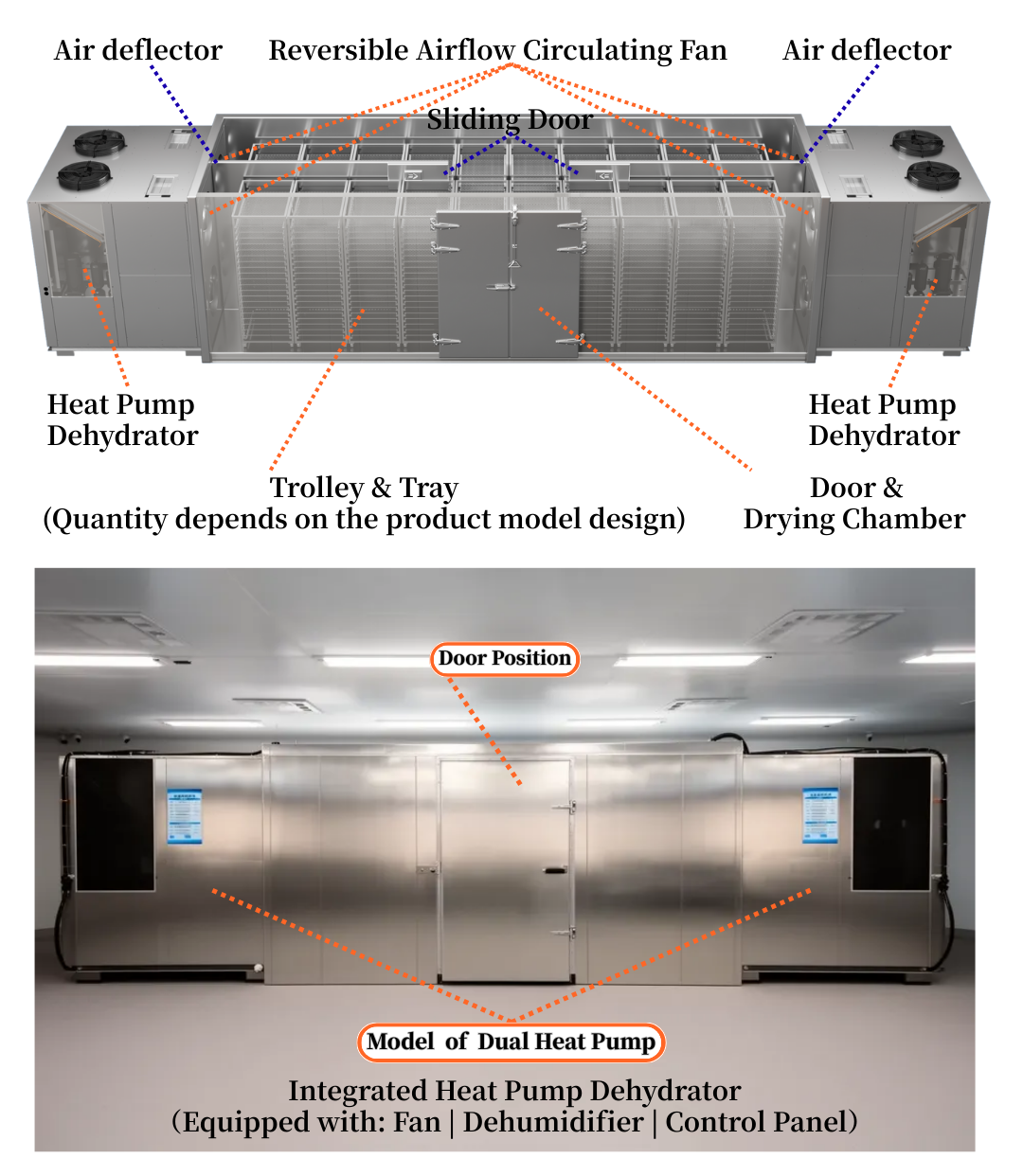
  • Auto-Reverse Fan System: Fans automatically switch direction periodically (e.g., every 1-2 hours), preventing persistent hot/cold spots.
  • Eliminates Thermal Gradients: Alternating airflow breaks up static temperature zones, ensuring even heat distribution.
  • Balances Product Exposure: Products alternate between being near and far from the air source, achieving uniform heat absorption over time.
  • Prevents Localized Over-Drying: Direction switching avoids concentrated heat on any side, protecting product quality.
  • Promotes Even Heating & Moisture Release: Products absorb heat from alternating angles, distributing heat more evenly and facilitating consistent moisture evaporation.

The following figure shows the enhanced bidirectional airflow diagram:
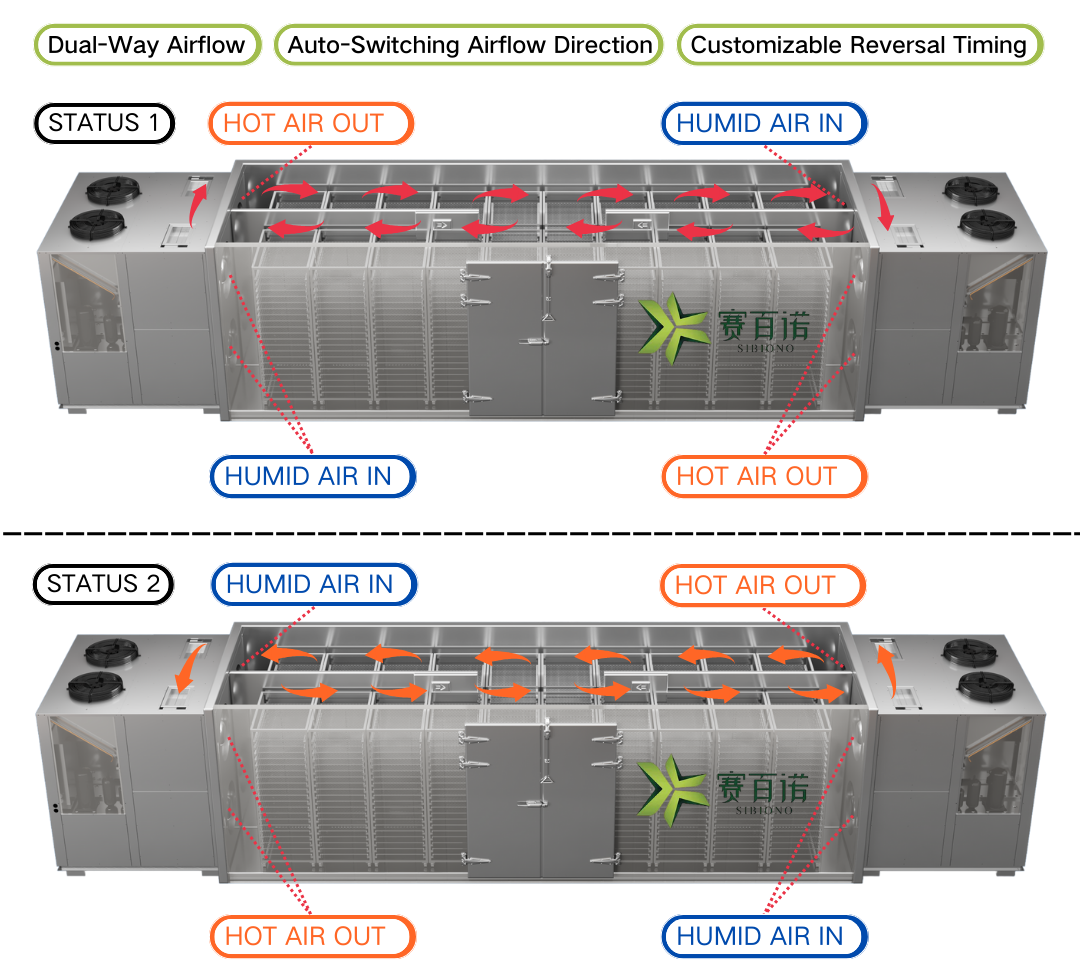
Bidirectional Airflow Diagram
3. Current Model Specs
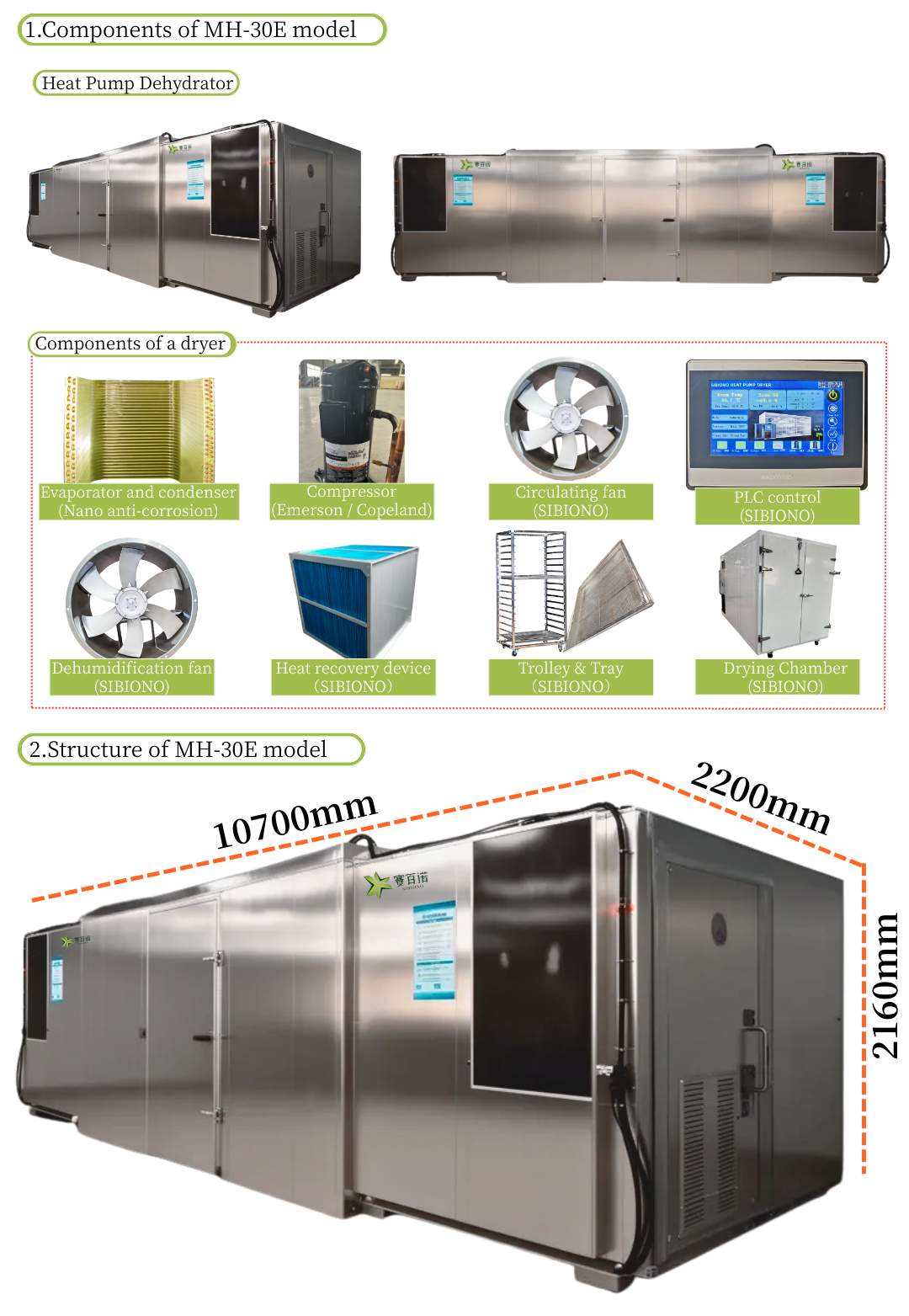
Dehydrator Spec Image 1
Dehydrator Spec Image 2
Dehydrator Spec Image 3
Dehydrator Spec Image 4
Specifications of the Current Model Dehydrator
MH-30E : Application & Capacity (batch)
Products Capacity (KG/Batch) Products Capacity (KG/Batch)
Mango 1500 Abalone 1920
Pineapple 1920 Sea Cucumber 1920
Apple 1200 Small Fish 1680
Fig 1440 Large Fish 2400
Lemon 1200 Beef Strips 1680
Apricot 2400 Beef Slices 1200
Banana 1200 Pork Slices 1200
Kale 1680 Chicken Jerky Slices 1200
Sweet Potato 1200 Duck Jerky Slices 1200
Tomatoes 1440 Antlers 1680
Onion 1680 Sardines 1680
Garlic 2400 Shrimp 2400
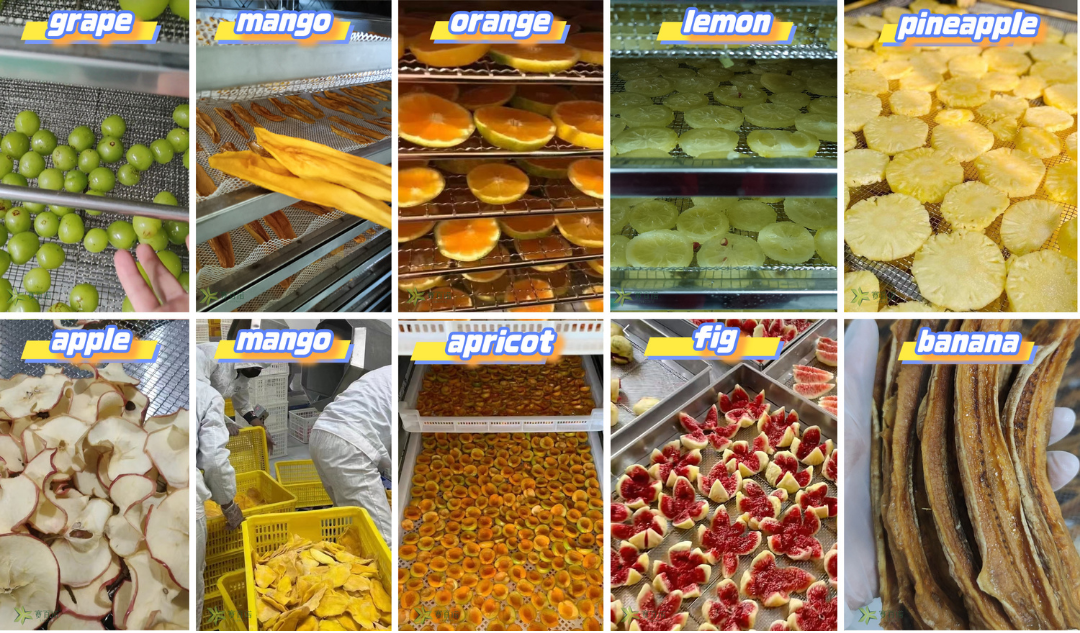
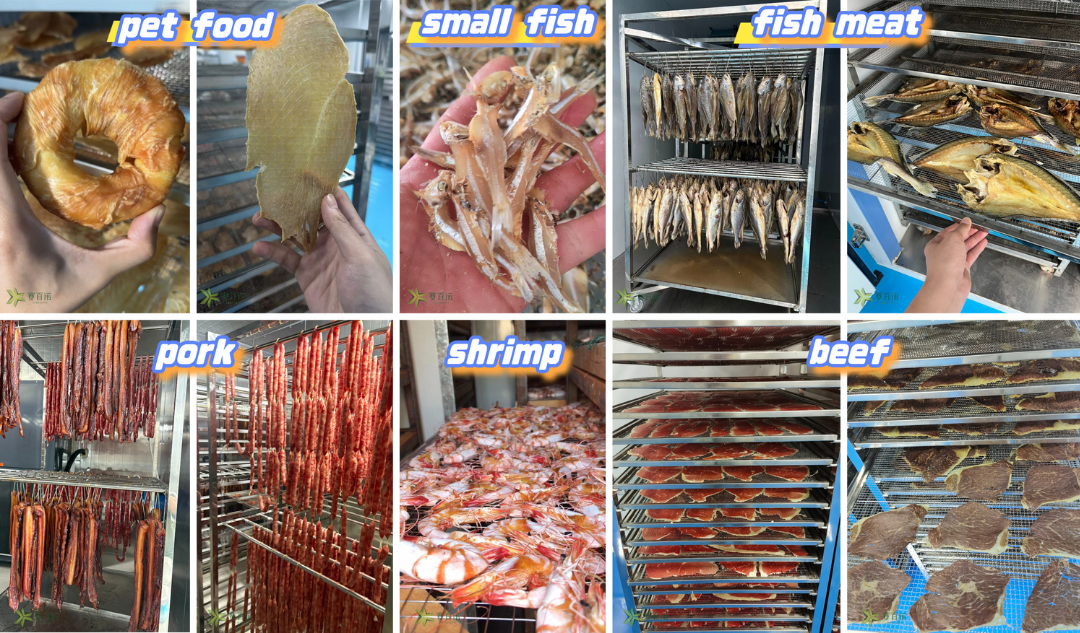
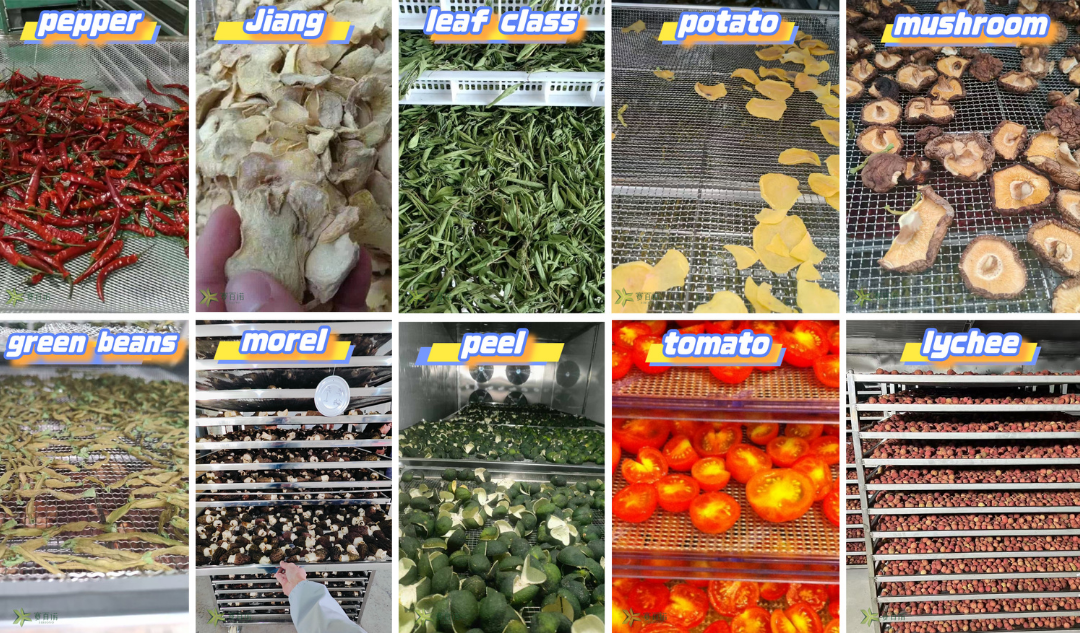
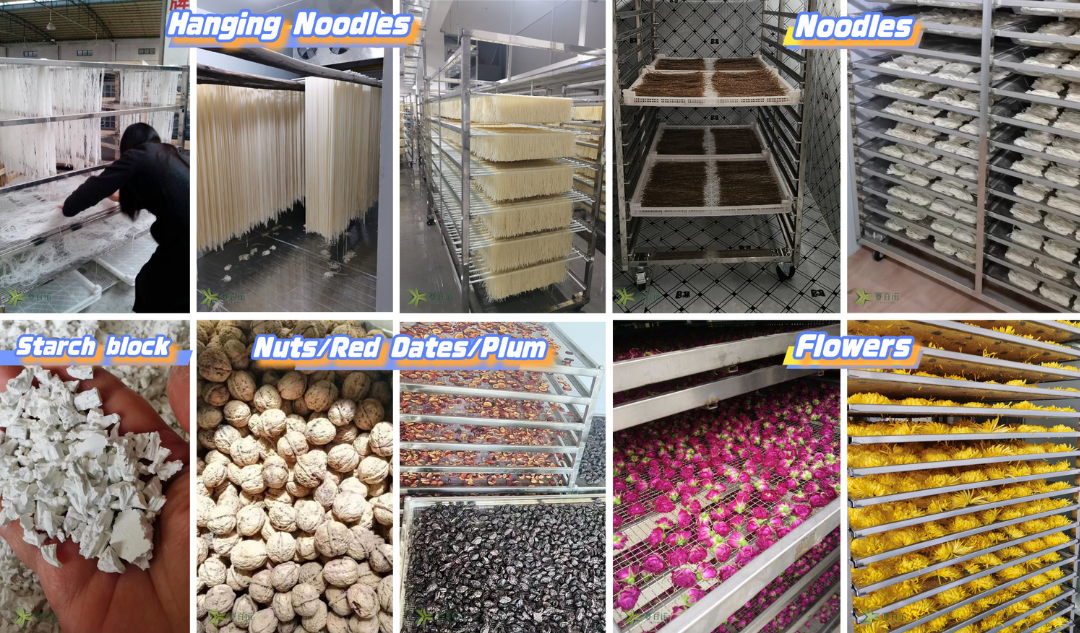
Applications: Fruits, pet food, vegetables, meat, fish, spices, noodles, seeds, grains, industrial products, etc.
Loading Capacity Guide per Tray:
1. Thinly Sliced: 1.5 - 2.5 kg per tray.
2. Thickly Sliced: 3.0 - 3.5 kg per tray.
3. Large Chunks/Cubes: 4 kg per tray.
4. Whole Fruits: 4 - 5 kg per tray.
5. Bones: 4 - 5 kg per tray.
MH-30E : Power & Energy Consumption
Model Unit MH-30E
Power supply / 380V-3PH-50HZ
Rated Power KW 41.4
Rated Current A 82.8
Auxiliary heating power KW 30
Maximum Power KW 71.4
Maximum Current A 136.8
Min power (CW) KW 15
Energy/hour (average) KWH 25 - 30
Input power for each state Rapid heating 71.4 KW
Normal mode 41.4 KW
Constant temperature state 15 KW
MH-30E: Structure & Material & Component
Model Unit MH-30E
Material No. / M01 - M07 (7 materials available to choose from)
Enclosure material / Sel. from: M01-M07
Dimension MM L10700 * W2200 * H2160
Chamber material / 100MM polyurethane | Surface: Sel. from: M01-M07
Drying Chamber Floor Load-Bearing Layer MM 2
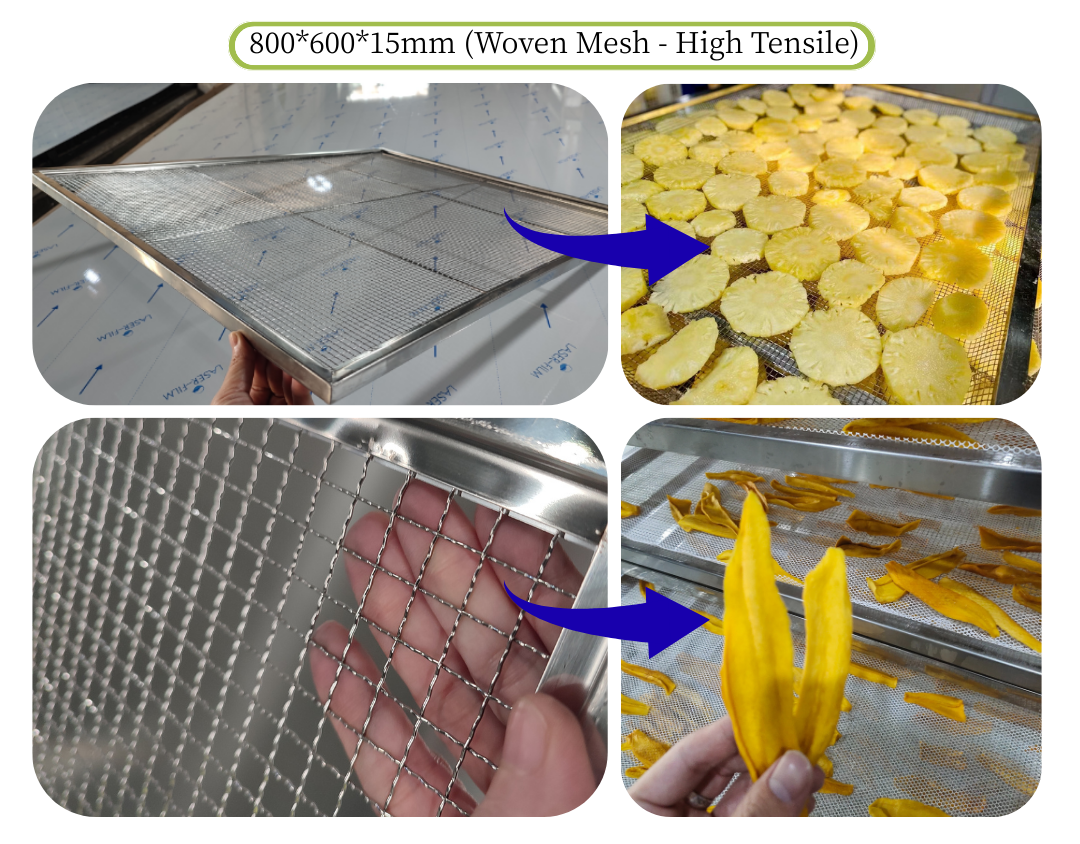
Tray size MM 800*600*15MM
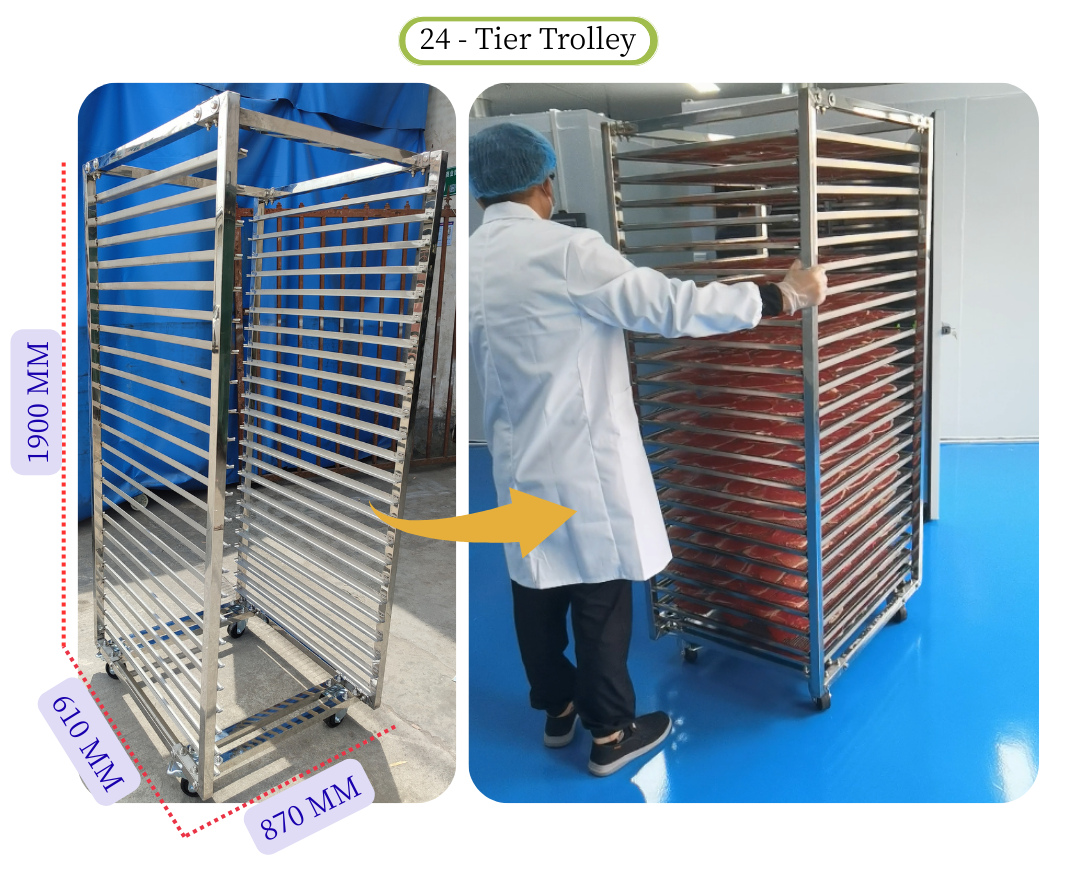
Qty of Trays & Trolley / 20 Trolley & 480 Tray
Tray material / SUS 304
Tray Wire Diameter MM 0.81
Tray Mesh Aperture MM 6*6
Contactor brand / Schneider
Compressor model / ZW-79KAE(Copeland) * 4 unit
Fan type / Axial flow fan
Control screen size / 10-inch
Refrigerant / R134a | 4500g * 4
Copper tube anti-corrosion / Nano coating(default)
Condenser Specifications / φ9.52MM corrugated copper tube
Evaporator Specifications / φ9.52MM corrugated copper tube
MH-30E : Performance & Function
Model Unit MH-30E
Rated heating capacity KW 110
Max heating capacity KW 137
Rated cooling capacity KW 75
Max Discharge Pressure Mpa 3
Temperature range 15 - 80
Temperature difference ± 1
Humidity range % 5 - 99
Humidity difference % ± 2
Fans / 8 pcs 1.5kw (φ74cm) Axial Fan (Bidirectional Airflow)
Dehumi fans / 4 pcs 0.75kw
Wind speed index M/S 5 - 6
Circulating Air Volume M³/H 112000 - 144000
Program Control / Multi-stage (≤ 10 stages), recipe storage (≤ 20 presets)
Heat Pump Type / Open-loop
Moisture Removal L/H 120 - 160
Time efficiency of heating to 75 ℃ without load / Normal mode: ≤ 20 minutes; Rapid heating: ≤ 10 minutes;
Safety Protections / Overload, overheat, phase sequence, leakage, high/low pressure, etc.
4. Principles & Control Systems
About the Food Heat Pump Dryer

Working Principle:

  1. An electric heat pump circulates refrigerant to absorb, compress, and transfer heat.
  2. Gentle low-temperature air (15–80°C) is circulated by fans through a closed-loop drying chamber.
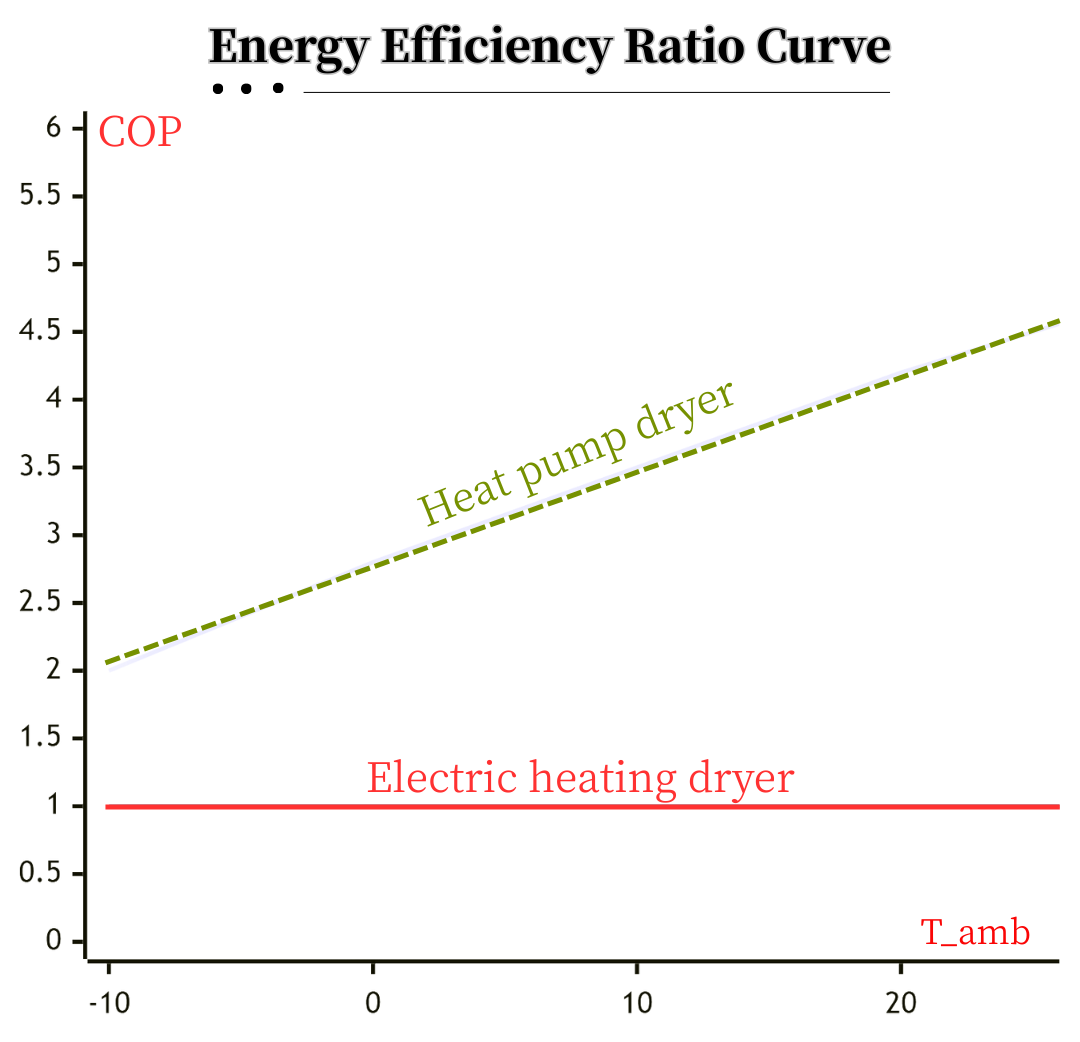
  3. Achieves a COP of up to 4:1, making it one of the most energy-efficient electric dehydrator types.

Advantages:

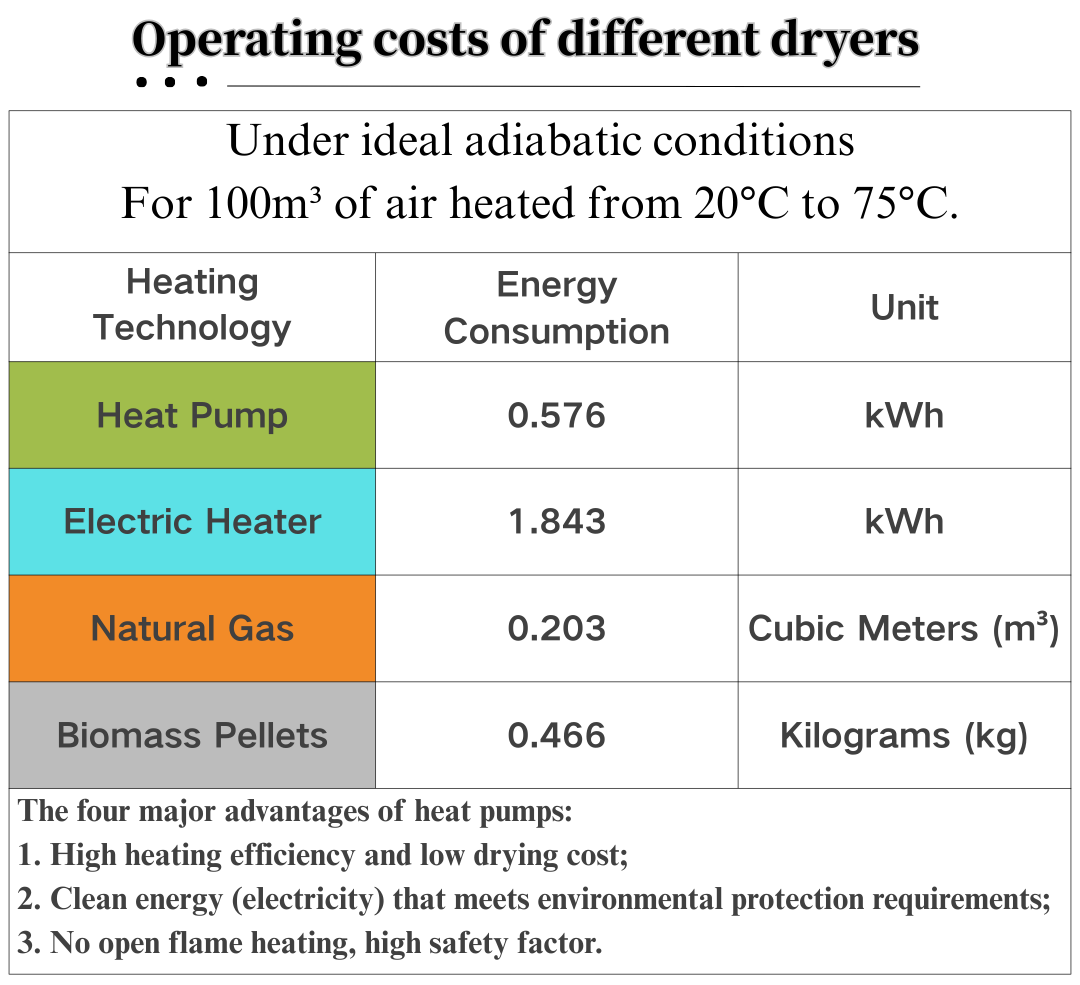
  1. Saves up to 70% energy compared to conventional electric dehydrators.
  2. Preserves product quality: low-temperature drying retains nutrients, color, and flavor.
  3. Eco-friendly & safe: no combustion, zero CO₂ emissions, and equipped with electrical safety protection.
Working Principle Illustration 1
Working Principle Illustration 2
Select heat pump by conditions

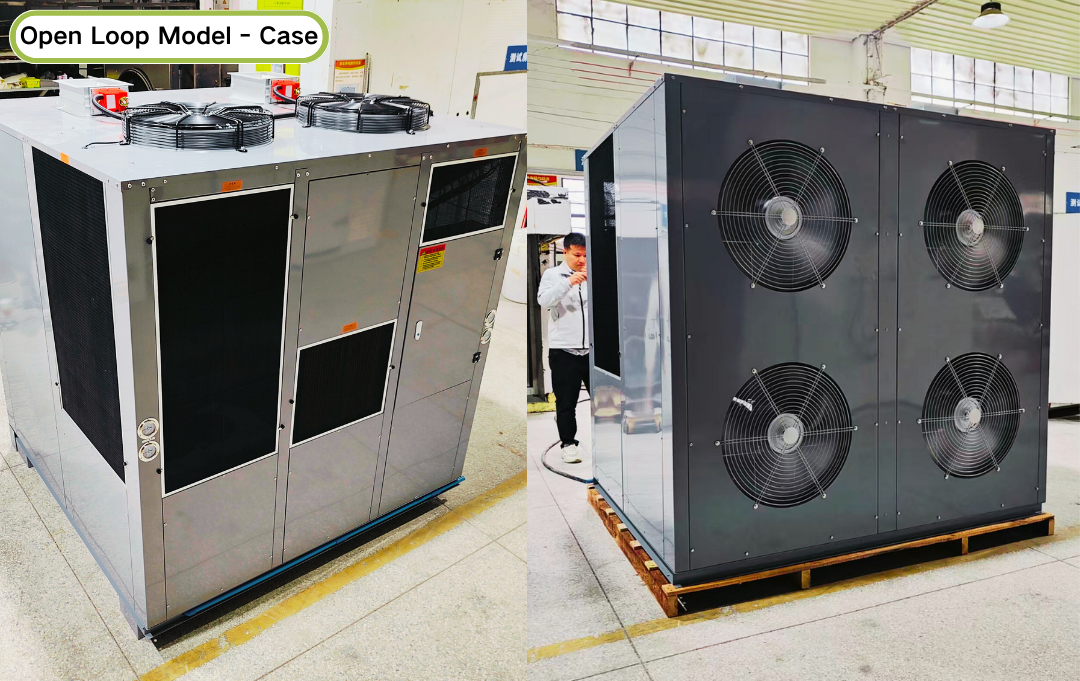
A. Temp > 5°C: Open-loop (default, most energy saving, no frost).

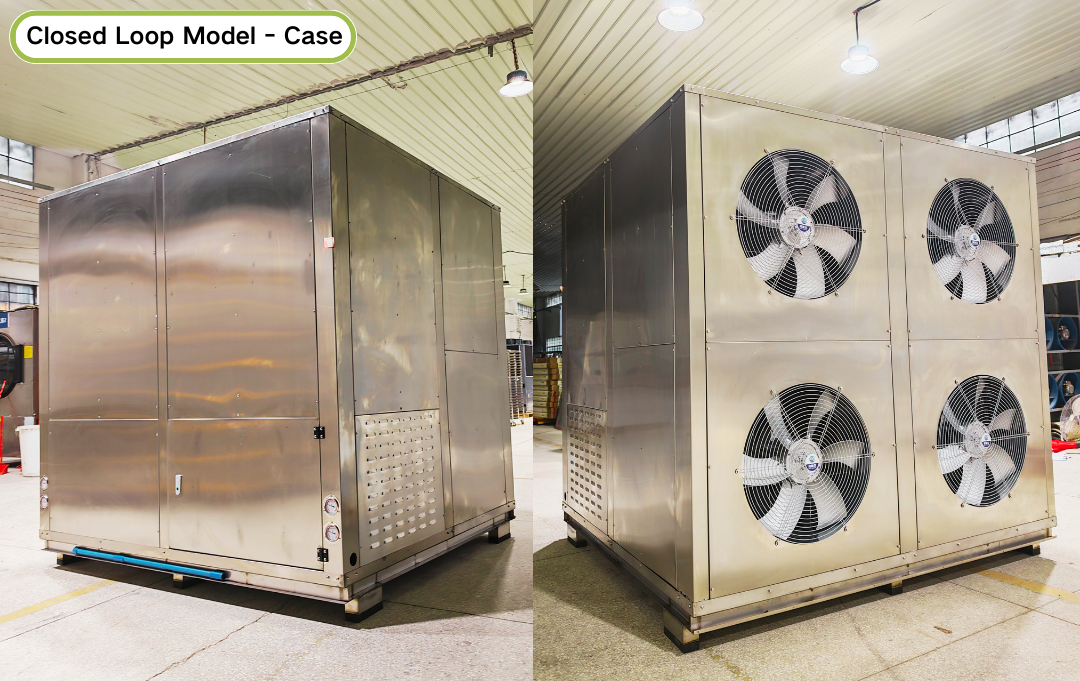
B. Temp < 5°C: Closed-loop (EVI compressor, stable).

C. Food/Corrosive Products: 304 or 316 stainless steel.

D. Other Products: Pre-coated steel, anti-corrosion paint, carbon steel, etc.
System Configuration Option 1
System Configuration Option 2
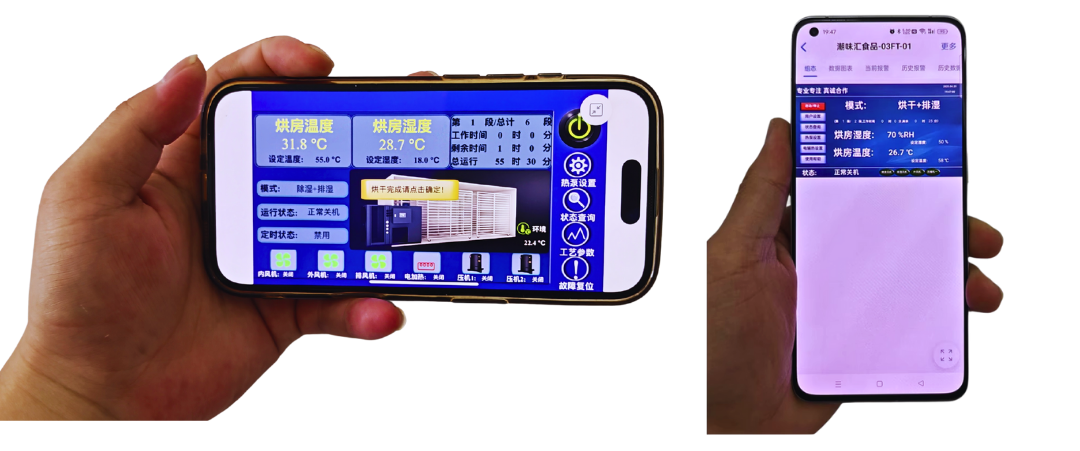
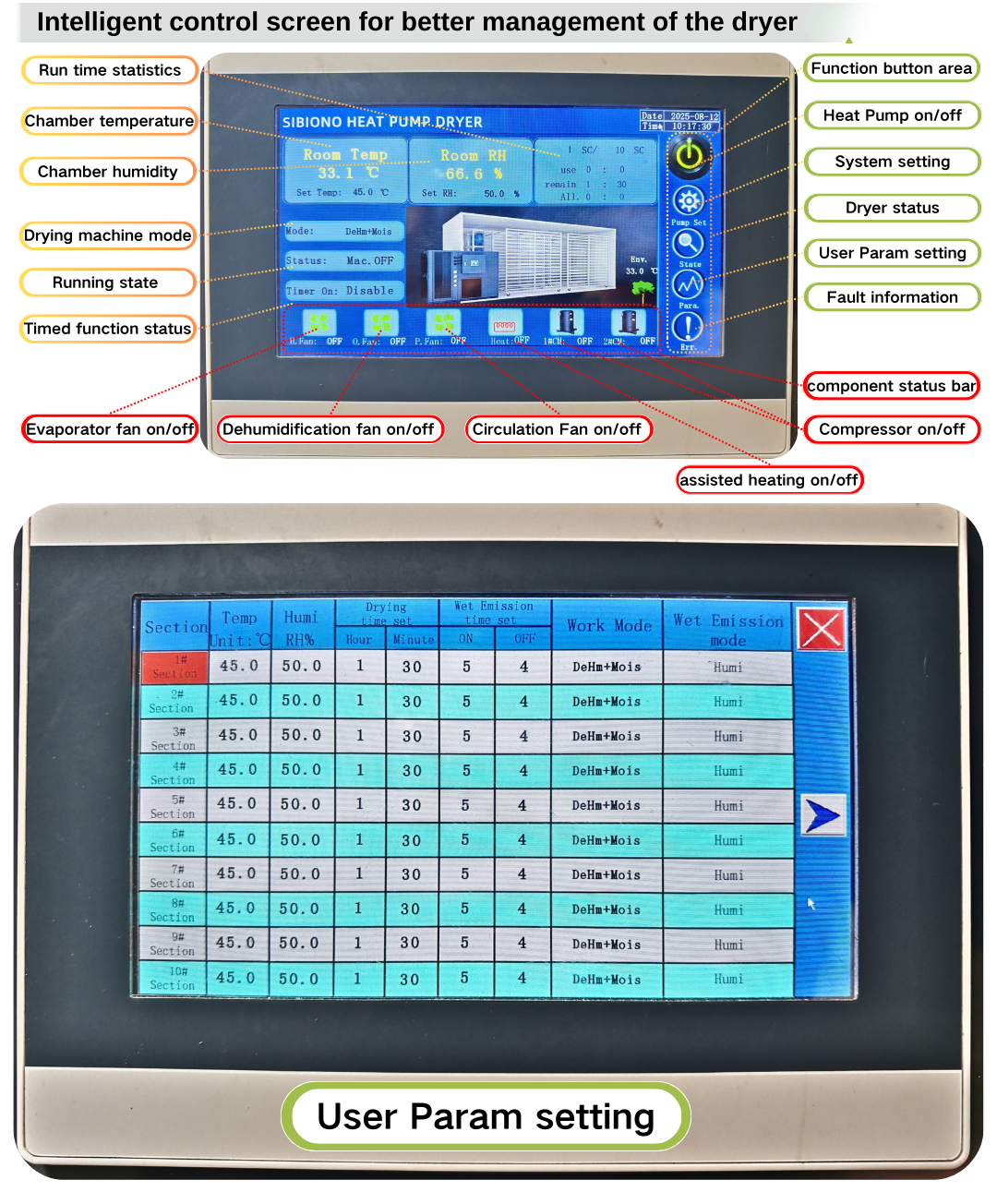
Control screen + APP control

Screen Size: 10-inch touchscreen

User Functions:

  1. Custom Programs: Set temperature, humidity & runtime (≤ 10 stages)
  2. Operational Modes: Combined drying/dehumidification/aux. heat modes (≤ 10 stages)
  3. Scheduling & Recipes: Delayed start + 20 preset drying recipes
  4. APP Control: WiFi-enabled for remote monitoring & control via mobile app
  5. User parameter limit: Temperature 15-80 ℃ + Humidity 5-99%

System Features:

  1. Fault Alerts: Real-time diagnostics with error codes displayed on screen & app
  2. Network Connectivity: Integrated WiFi module
  3. System Parameters: Adjustable thermal limits, safety protocols & expansion valve controls
Control System Interface
Mobile App Control
5. Project Cases & Examples
Mango Drying Case
Case: The drying process of mango

Stage 1: Rapid surface drying to prevent oxidation (65-75°C, ≤ 40% RH, 5-6 H).

Stage 2: First temperature drop & steady dehydration (58-60°C, ≤ 25% RH, 7-8 H).

Stage 3: Second temperature drop & steady dehydration (50-58°C, ≤ 20% RH, 6-7 H).

Other: Quick drying method: Dry at high temperature of 60-75 ℃ for 12-15 hours. The disadvantage is that the dried mango is too hard and requires a softening process.
Chicken Breast Crisps
Chicken Breast Crisps (3.5-3.8mm thick)

Stage 1: Pre-cooking & initial drying at 65°C (≤ 50% RH) for 3-5 H.

Stage 2: Final drying at 55°C (≤ 13% RH) for 6 H to achieve durable crispness.

Note: Time adjustment by thickness:
* 2mm thick: 5-6 H drying time.
* 3mm thick: 6-7 H drying time.
* 4-5mm thick: 11-13 H drying time.
Drying Whole Peppers

Stage 1: High temp (65-75°C, ≤ 60% RH, 8 H) to soften skin & release moisture.

Stage 2: Steady drying (60-65°C, ≤ 13% RH, 12-14 H) to 8-10% final moisture.

Note: For green peppers (sliced): Start low (35-40°C) to rapidly vent steam & retain color, then gradually increase to 55-60°C for final drying.
Flower Drying
Flower Drying & Hydrosol Extraction

Dried Rose Buds & Rose Hydrosol:

Stage 1: Low temp (20-25°C, ≤ 60% RH, 10 H) for hydrosol extraction.

Stage 2: Higher temp (40-50°C, ≤ 22% RH, 12-14 H) for final drying.

Note: Requires fully closed-loop heat pump to retain hydrosol.
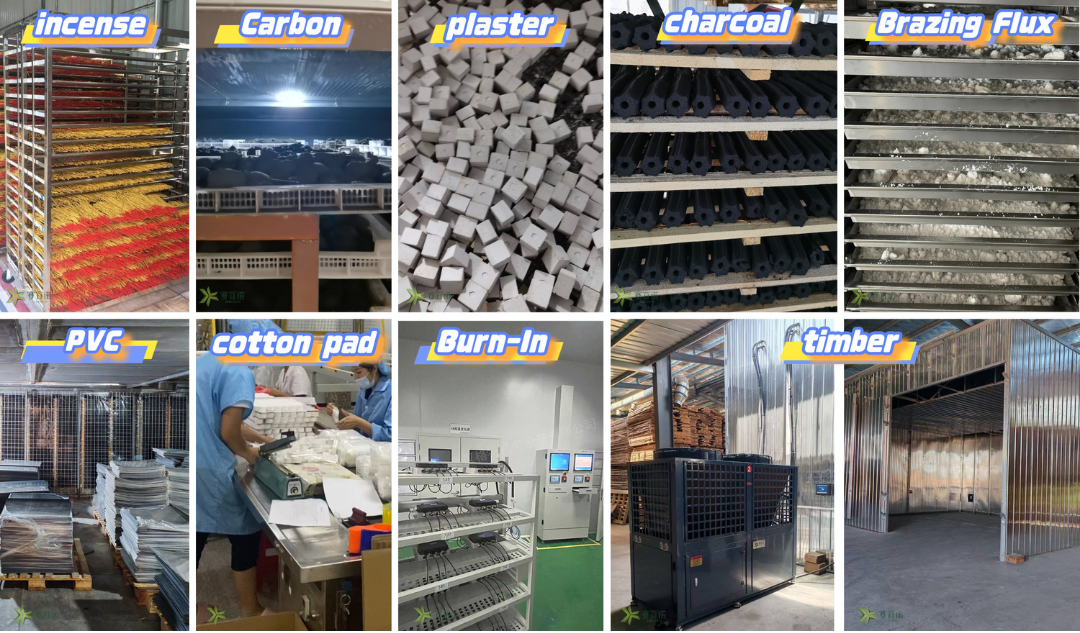
Charcoal Drying
Charcoal Drying

Stage 1: Medium temp/high humidity (50-60°C, ≤ 70-90% RH, 8 H).

Stage 2: 60-70°C, from ≤ 70% to ≤ 35% RH, 8 H.

Stage 3: 65-70°C, ≤ 10% RH, 8-10 H.

Safety requirements:
1. No Overheating - Risk of fire.
2. Class A Fireproof Insulation required.
3. Control Initial Humidity to prevent cracks.
4. Adjust Time by charcoal size.

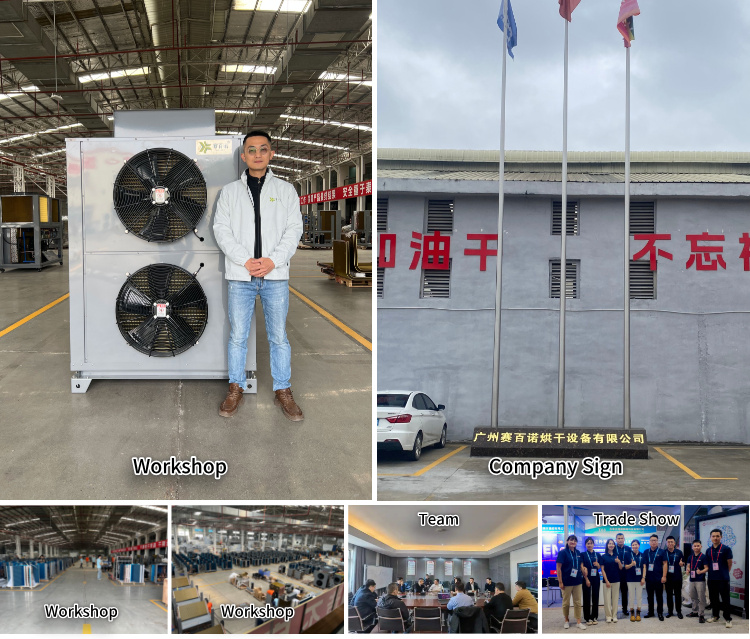
6. Factory and Service
Service Process

A. Payment: Secure & convenient, primarily via T/T (Telegraphic Transfer).

B. Pre-Sales & Tech Support:

  1. Free System Design: We analyze your material and goals to recommend the optimal model.
  2. Process & Corrosion Strategy: We advise on the best system type (open/closed loop) and anti-corrosion solutions.
  3. End-to-End Engineer Support: Our team assists with installation, commissioning, and startup.
  4. Long-Term Parts & Support: Available during and after the warranty period.
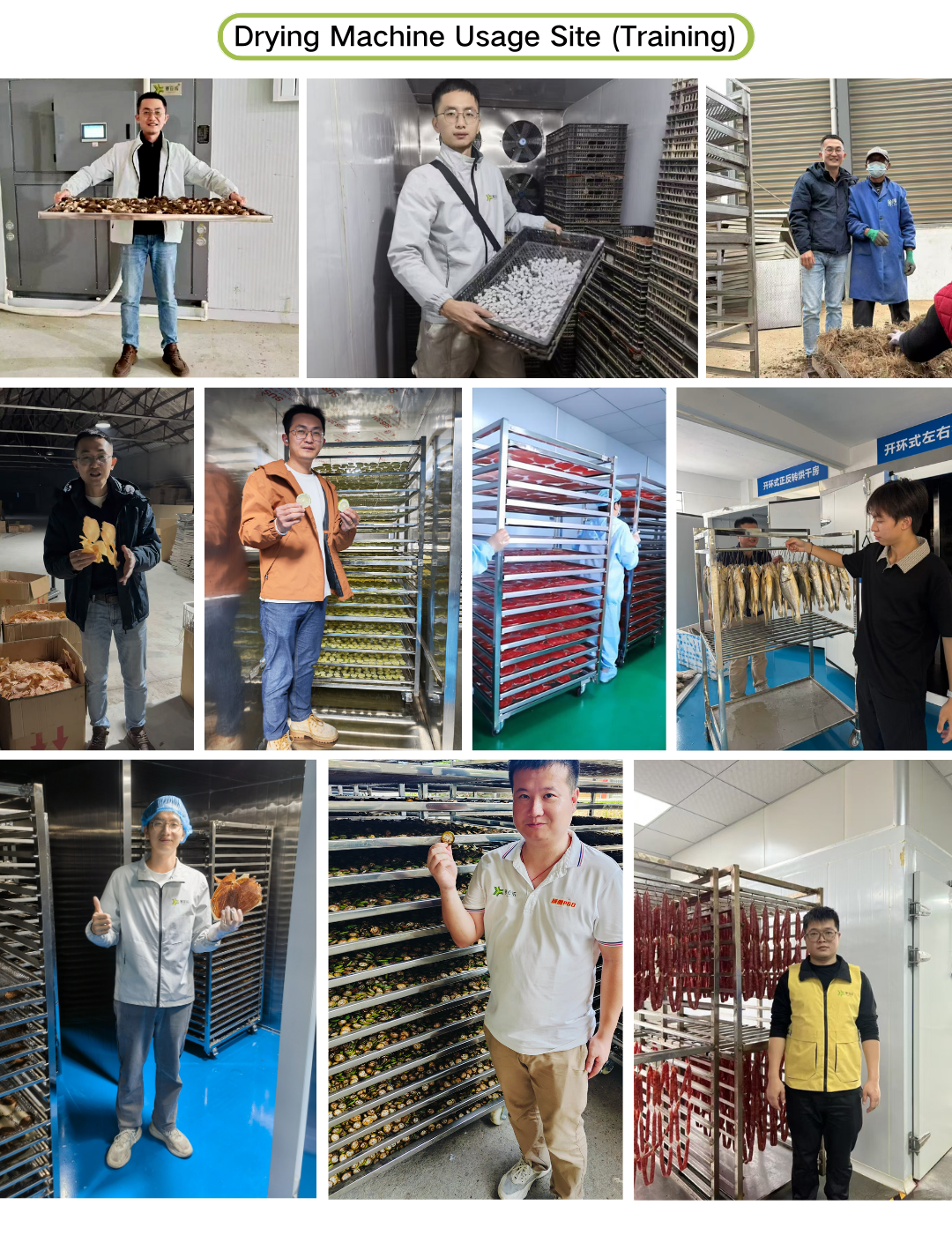
  5. Training Documentation: Provided for your operators.

C. After-Sales & Warranty:
  1. Process Optimization: We remotely assist with trials, record data, and deliver a stable, optimized drying recipe.
  2. Video Call Support: Quick troubleshooting for installation, operation, and maintenance.
  3. Warranty: 1-year comprehensive warranty. Extended plans available.
  4. Lifetime Support: Genuine spare parts and technical support at competitive prices for the life of your machine.
Service Support Process
Certificates and Documentation
7. Packaging & Shipping
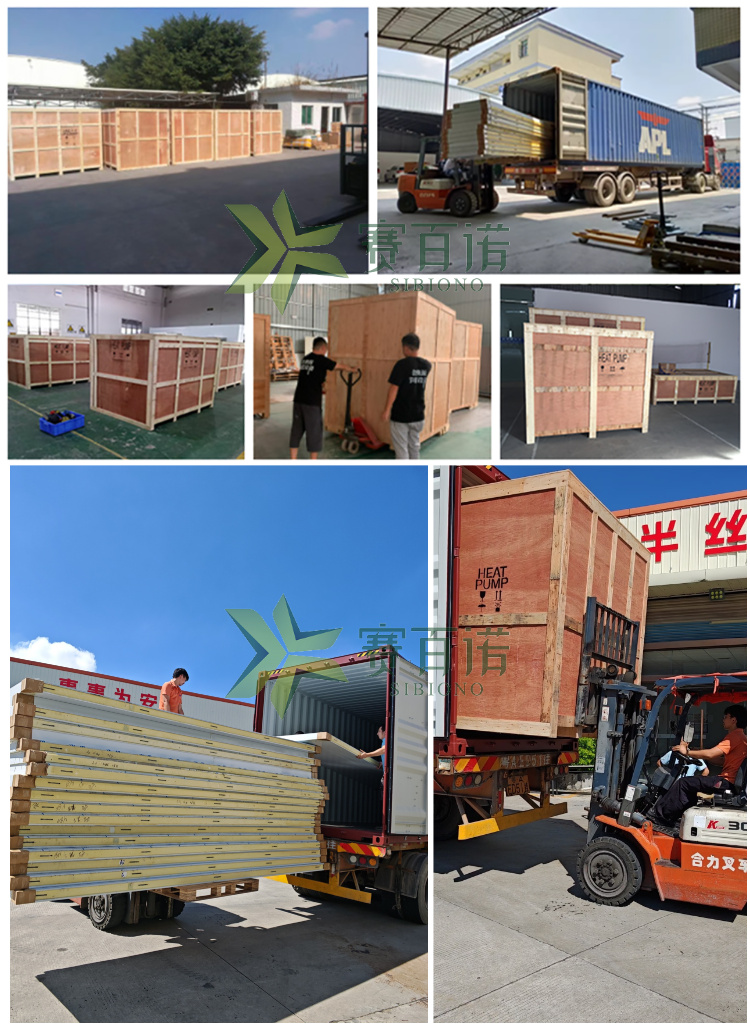
Packaging and Shipping Process
8. FAQ & Install
Q1 What is the main advantage of a heat pump dryer compared to traditional methods?
The core advantage is exceptional energy efficiency (saving 50-70% energy) and gentle, low-temperature drying (typically 35-75°C), which preserves the color, flavor, nutrients, and appearance of your products far better than high-temperature hot air or smoking methods.
Q2 Can it dry all types of food?
Yes, it is highly versatile. There are successful cases for fruits, vegetables, herbs, spices, meats, seafood, edible flowers, and high-value ingredients. The key is customizing the drying program (temperature, humidity, time) for each product.
Q3 How is the moisture removed without venting humid air outside?
The dryers use a closed-loop dehumidification system. Moist, warm air passes through an evaporator where moisture condenses into water and is drained away. The dry, cool air is then reheated by the heat pump and recirculated. No exhaust is needed, saving energy.
Q4 What is the minimum and maximum drying temperature?
Our standard range is 15°C to 80°C. The low start temperature is ideal for delicate products (like herbs or flowers), and the high temperature can handle rapid drying of some vegetables or fruits.
Q5 Can it work in cold climates?
Yes. For environments consistently below 10°C, we recommend our low-temperature models equipped with EVI (Enhanced Vapor Injection) compressors, which maintain high efficiency and stability down to -20°C.
Q6 Is the machine difficult to operate and maintain?
No. It features a user-friendly touchscreen with pre-set and customizable programs. Regular maintenance mainly involves cleaning filters and condensers—simple tasks we will train your staff to perform.
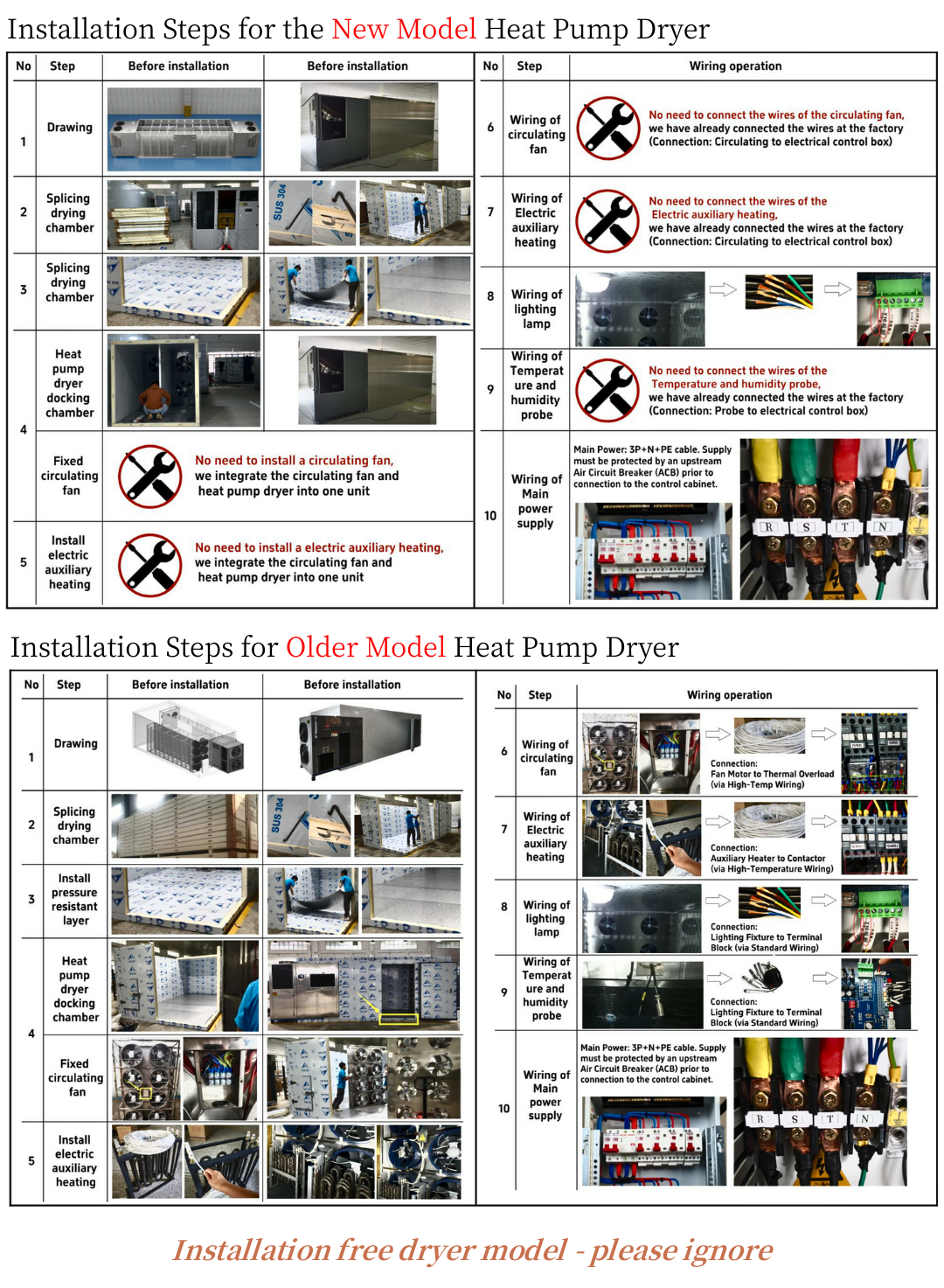
FAQ and Install Reference

Related Products